
NameProof
Choosing a Business Name: How to Decide Between Your Shortlist
A practical way to choose between your final business name candidates: what rules a name out, what is only a trade-off, and in what order to check.
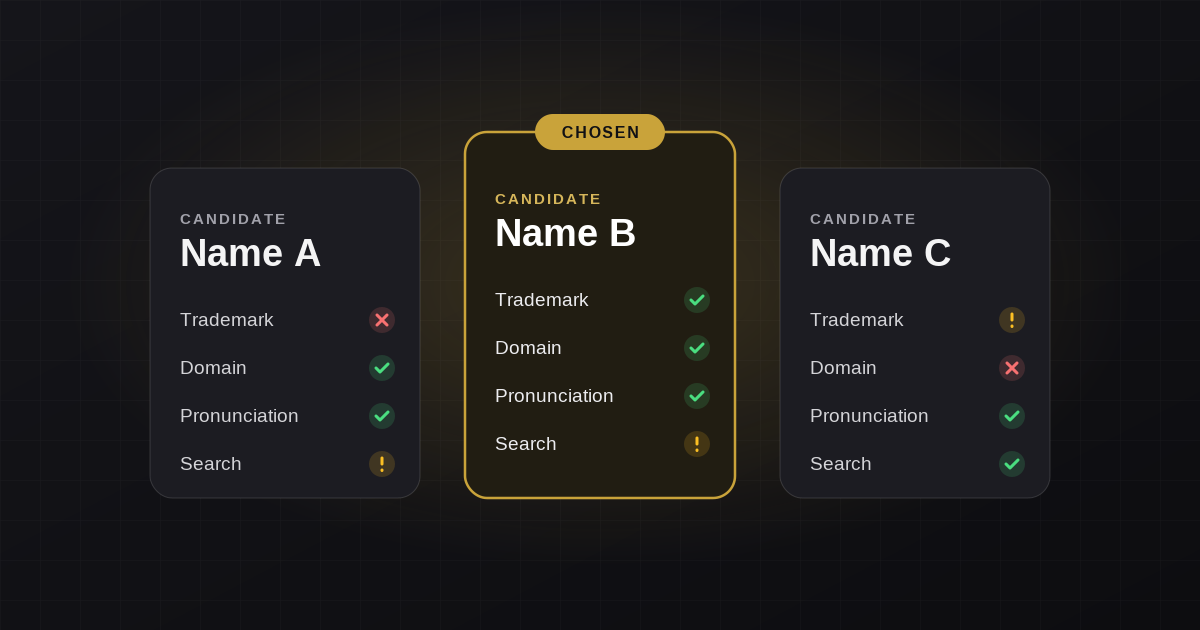
Most founders do not struggle to come up with names. They struggle to choose. After a few rounds of brainstorming, there are usually two to five candidates left, each with something going for it, and no obvious way to decide. This guide is about that final step: how to compare a shortlist so that the name you pick is one you can build on.
Key points
- Separate deal-breakers, which rule a name out, from trade-offs, which you can weigh.
- Check the decisive things first: an existing trademark or business in your field matters more than a missing
.com. - Score the survivors on the same few criteria, then test them on real people.
- Registering a company name and owning a trademark are usually two different things.
Start by writing down what the name has to do
A name is good or bad only in relation to the business behind it. Before comparing candidates, spend ten minutes writing down the context they have to work in. It makes every later judgement easier and less emotional.
- Where will you operate? The countries and languages you care about decide which registries you need to check and which pronunciations matter.
- How will customers find you? If most customers will search for you online, search competition matters more than if you sell through a few personal relationships.
- How broad will the business become? A name tied closely to one product or city can feel limiting if you later expand.
- How will the name be heard? Names that are spoken on calls, in podcasts or in recommendations need to be easy to spell after hearing them once.
Keep this list next to your shortlist. When two names seem equally good, the context usually breaks the tie.
Separate deal-breakers from trade-offs
The most useful thing you can do with a shortlist is sort problems into two groups. A deal-breaker removes a candidate, no matter how much you like it. A trade-off is a weakness you can accept if the name is strong elsewhere.
Typical deal-breakers
- A similar existing trademark in your field and markets. Trademark conflicts are generally not limited to identical names. Similarity in sound, appearance or meaning, combined with related goods or services, can be enough to cause problems.
- An established business using the same or a very similar name for similar products in your market, even if it has not registered a trademark.
- An unfortunate meaning or pronunciation in a language that matters to your customers.
- No workable web address at all, for example when the obvious domains are used by a business in a related field and every alternative would be confusing.
Typical trade-offs
- The exact
.comis taken, but a clear alternative domain is available and not used by a related business. - A social media handle needs a small addition, such as a suffix, to be available.
- The name contains a common word, so it will take more effort to rank in search results.
- The name is a little long, or has one letter people might spell two ways.
Writing problems down in these two columns stops a small irritation, such as a missing .com, from outweighing
a serious risk, such as a competitor with a similar registered mark.
Check candidates in the right order
Checks differ in how decisive they are. Run the ones most likely to eliminate a name first, so you do not invest time in a candidate that a five-minute search would have ruled out.
- A plain web search. Search for the name on its own and with a word describing your business. If a business in your field appears on the first page, look more closely before going further.
- Trademark databases for your markets. Free official tools include the USPTO trademark search (opens in a new tab) for the United States, TMview (opens in a new tab) for the EU and many national offices, the WIPO Global Brand Database (opens in a new tab) and the UK trade mark search (opens in a new tab). Look for similar names as well as exact matches, in the classes of goods and services that relate to your business. NameProof has a step-by-step guide on how to run a trademark search for a startup name (opens in a new tab).
- Company registers. Check the business registers where you plan to incorporate or trade, such as Companies House (opens in a new tab) in the UK or the relevant state register in the United States.
- Domains and social handles. Availability matters, but so does who is using the taken ones. An unused, parked domain is a different situation from an active business in your sector.
- Language and pronunciation. Say the name out loud in the languages of your main markets, and check for meanings you may not know about.
None of these checks is a legal clearance. Their purpose is to find obvious problems early and cheaply, so that the candidates left standing deserve a closer look. Tools such as NameProof (opens in a new tab) can run several of these checks together and summarize the signals, but they are a screening step too, not a legal opinion.
Compare the survivors on the same criteria
Once the deal-breakers have removed some names, compare the rest side by side. A simple table works well. Score each criterion from 1 to 3 and add a short note explaining the score. The notes matter more than the totals.
| Criterion | Candidate A | Candidate B |
|---|---|---|
| Distinctive in your market | 3: no similar names found in your field | 2: one similar name in a neighboring field |
| Easy to say and spell | 2: one letter is often misspelled | 3: spelled correctly after hearing it once |
| Fits future scope | 3: not tied to one product | 2: suggests a single product line |
| Domain and handles | 2: needs an alternative domain | 3: matching domain and handles available |
| Search competition | 3: few results for the term | 1: shares a common word |
In this illustration the totals are close, but the notes point to a clear choice: Candidate B’s similarity to another business and its tie to one product line are harder to fix later than Candidate A’s spelling issue.
Test the finalists on real people
Two quick tests reveal problems that a desk review misses. Neither requires a formal survey.
- The spell-back test. Say the name once to someone who has not seen it written, then ask them to type it into a search box. If people regularly spell it differently, customers who hear about you will struggle to find you.
- The description test. Tell people only the name, then ask what they think the business does. You are not looking for a perfect answer; you are checking that the name does not point people in the wrong direction.
Decide, then secure the name in a sensible order
Once you have a favorite, move from quick checks to firmer steps. The right order depends on how much you are about to invest, but a risk-aware sequence usually looks like this:
- Finish your preliminary screening. Run the checks above on your final candidate and note anything uncertain, such as a similar mark for related goods or services.
- Get a professional assessment when the stakes or the doubts justify it. If your screening raised questions, or you are about to invest significantly in branding, a launch or international expansion, ask a qualified trademark professional for advice before you commit. Changing a name now costs far less than changing it after launch.
- Secure the domain and social handles. They are inexpensive and can disappear quickly, so many founders register them as soon as a name looks viable, accepting that they may let them go if a later check rules the name out.
- Register the business, if you have not done so already, under the name you have checked.
- Protect the name as a trademark in the markets that matter to you, with professional help where needed. Timing can matter: in many countries, trademark rights depend largely on who files first.
It is worth remembering that, in many countries, registering a company name and holding a trademark are separate matters. A company registration usually confirms that the name is available on that register; it does not necessarily give you the right to stop others from using a similar brand. NameProof explains the difference in Can two companies have the same name? (opens in a new tab)
Common mistakes to avoid
- Deciding before checking. The longer you use a name internally, the harder it is to drop when a problem appears.
- Treating domain availability as the decision. An available domain says nothing about trademarks or existing businesses.
- Checking only your home market. If you plan to sell abroad, the relevant registries and languages are part of the decision.
- Reading a clean search as a guarantee. Preliminary checks reduce risk; they do not eliminate it.
In short
Choosing between shortlisted names is easier when you stop comparing feelings and start comparing evidence. Write down what the name must do, remove candidates with deal-breakers, compare the rest on the same criteria, test them on real people and then move quickly to secure your choice. For a more detailed list of individual checks, see the NameProof startup name checklist (opens in a new tab).
This article provides general information only and is not legal advice. For trademark clearance and registration, consult a qualified intellectual property professional.