
NexusTri Insights
Better Business Decisions Start With Better Tools
What makes a business tool genuinely useful for decisions, where spreadsheets and AI fit, and a simple routine for checking a decision before you commit.
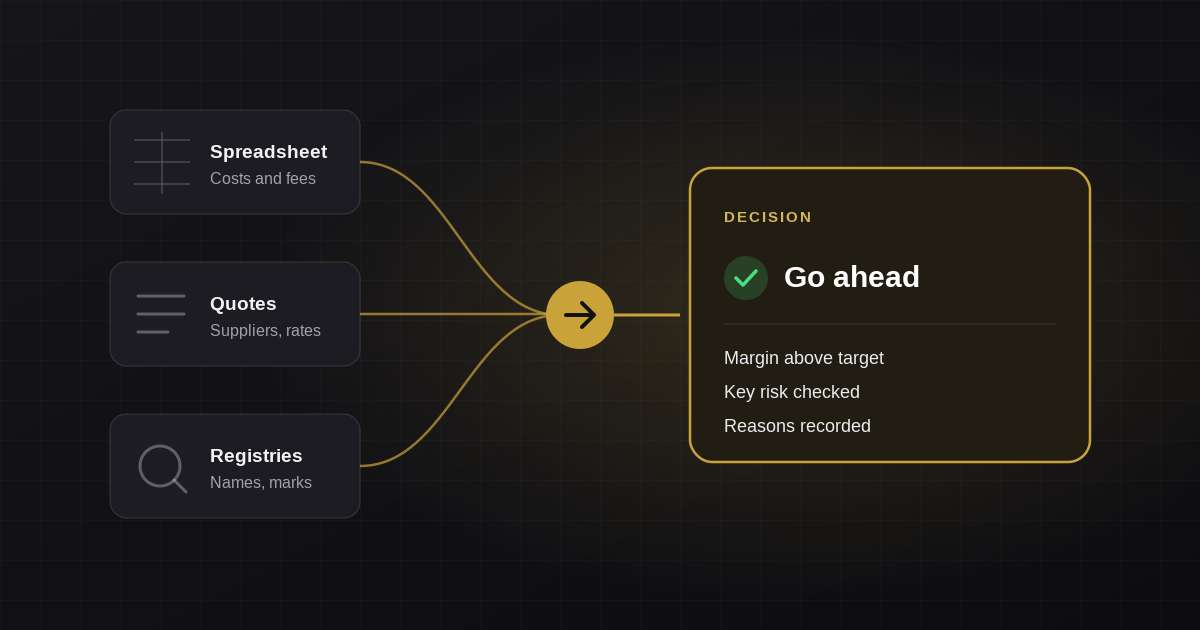
Many expensive business mistakes are not caused by a lack of effort or intelligence. They happen because a decision was made with information that was incomplete, out of date or spread across too many places to see clearly. The tools we use shape what we see when we decide, and that makes the choice of tools a business decision in its own right.
Key points
- A useful decision tool frames a specific question, shows the answer first and makes its assumptions visible.
- Reporting tools explain what happened; decision tools help before you commit. Most businesses need both.
- Spreadsheets are excellent for exploring, and riskier for repeated, high-stakes decisions.
- AI is a means, not a product. Ask what a tool calculates exactly and what it estimates.
What a useful decision tool does
There are tools for almost everything, and most of them produce more information than anyone can use. For decisions, more data is not the goal. A tool earns its place when it does five things well.
- It frames a specific question. “Should I sell this product at this price?” is a question. A dashboard with forty metrics is not. Tools built around a question lead you to the information that answers it.
- It asks for the right inputs, and shows what is missing. A result is only as good as what goes into it. Good tools make it obvious when an important input has been left out or estimated.
- It shows the answer first and the evidence second. A clear conclusion, followed by the reasons behind it, lets you act quickly and still check the reasoning when it matters.
- It makes assumptions explicit and testable. Every forecast rests on assumptions. You should be able to see them and change them to find out how sensitive the answer is.
- It is honest about its limits. A tool that supports a decision should say what it does not cover, and when you need a professional instead.
Looking back versus deciding ahead
Most business software is built to look back. Accounting systems, analytics and sales reports tell you what happened, and they are essential. But they report on decisions that have already been made.
Decision tools work at a different moment: before the order is placed, the price is published or the name is registered. That is the point where a change is cheapest. A business that only measures afterwards learns from its mistakes; a business that also checks beforehand avoids some of them.
Where spreadsheets fit
Spreadsheets are flexible, inexpensive and familiar, and for many questions they are the right tool. They are ideal for exploring a problem for the first time, building a quick model or working with numbers no product was designed for.
Their weaknesses appear when the same decision is made repeatedly or the stakes are high:
- A formula error can go unnoticed for a long time, because the result still looks plausible.
- Assumptions are often hidden in cells rather than stated.
- Templates get copied and modified until no one is sure which version is correct.
- The logic often lives in one person’s head, which becomes a problem when that person is unavailable.
A sensible rule is to use spreadsheets to explore, and move to a focused tool once a decision becomes routine and costly to get wrong. MarginGuides looks at this trade-off for margin calculations in When a spreadsheet is enough, and when it isn’t (opens in a new tab).
Where AI fits
Artificial intelligence is now part of many business tools, and it can be genuinely useful. It is good at working through large amounts of unstructured information, comparing text, spotting patterns and summarizing findings in plain language.
It is less suited to work that must be exact and repeatable. Calculating a margin, applying a fee schedule or checking whether a value meets a threshold should give the same answer every time. For that, deterministic logic, meaning fixed rules and formulas, is the better choice.
The most useful question to ask about any tool is not whether it uses AI, but which parts of the result are calculated exactly and which are estimated. A trustworthy tool can answer that clearly. AI is a means to a better answer, not the product itself.
Questions to ask before you rely on a tool
- Does it answer a specific question you actually face?
- Can you see the inputs and assumptions behind the result, and change them?
- Can you reproduce the result? The same inputs should lead to the same answer.
- Does it say what it does not do? Clear limits are a sign of a serious tool.
- What happens to your data? Read how the tool stores and uses the information you enter.
- How does its cost compare with the cost of a wrong decision? A modest tool that prevents one expensive mistake can be worth more than its price.
A simple routine for important decisions
Tools help most when they are part of a habit. Before any significant commitment, such as a new product, a large order, a price change or a new name, this short routine takes only a few minutes:
- Write the decision in one sentence. For example: “We will order 500 units from this supplier at this price.”
- List what would make it wrong. Costs higher than expected, a competitor with a similar name, demand lower than planned.
- Check those things first. Focus your time on the risks that would change the decision.
- Set your threshold in advance. Decide the minimum margin or the deal-breakers before you look at the numbers, not after.
- Record the decision and the reasons. A few lines are enough. They make it far easier to learn from the outcome later.
How this shapes what we build
These principles shape how we build software at NexusTri. The products we currently develop each address a specific decision: NameProof (opens in a new tab) helps founders check whether a business name is safe to build on, and MarginGuides (opens in a new tab) helps businesses see the real margin of a deal before they commit. Both lead with a clear result and show the evidence behind it, and both are explicit about what they do not replace. You can read more about our approach on our company page.
In short
Better decisions rarely come from more data. They come from asking a clear question, seeing the relevant facts in one place, understanding the assumptions and checking the risks before committing. Choose tools that make those steps easier, and be wary of tools that make them harder to see.