
MarginGuides
Why Your Profit Margin May Be Lower Than You Think
Six common measurement mistakes that make a profit margin look healthier than it is, with worked examples and the formulas to get a truer number.
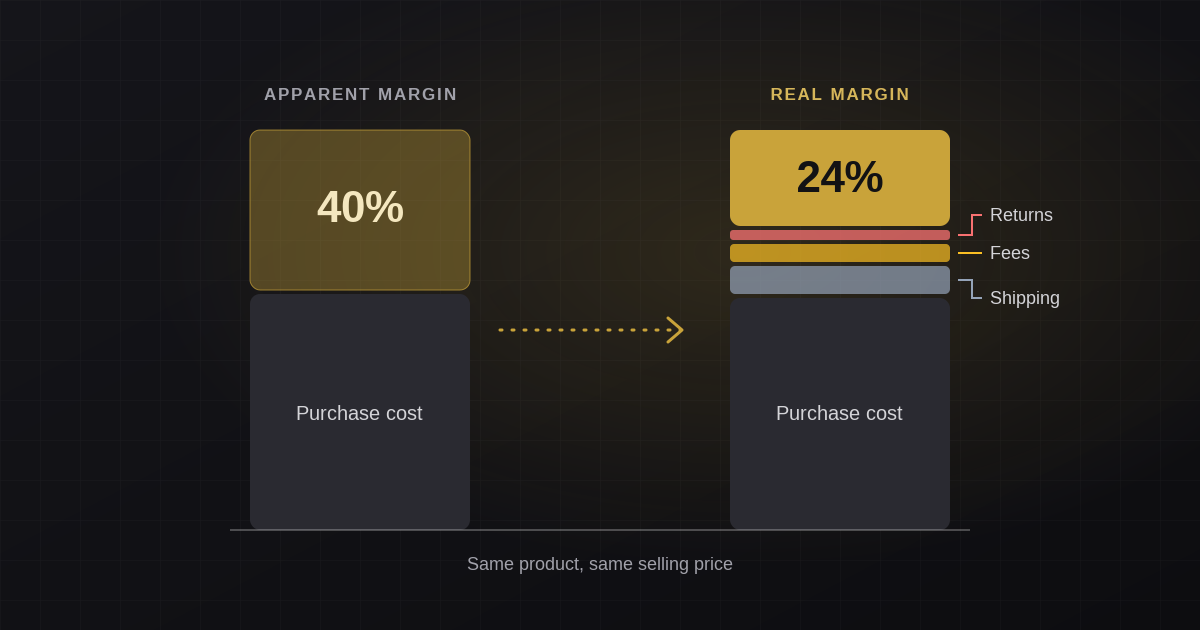
Sales are growing, the products sell, and yet there is less money left at the end of the month than expected. Often the reason is not that the business suddenly became less profitable, but that the margin was never as high as it appeared. The problem is in the measurement. This article looks at six common measurement mistakes and how to correct them.
Key points
- Margin and markup are different numbers. Confusing them is one of the easiest ways to overestimate profit.
- Percentage fees and discounts act on the price, so they hit margin harder than they appear to.
- Averages hide small orders and products that lose money.
- Returns, exchange rates and outdated costs belong in the calculation before you commit, not after.
1. Confusing markup with margin
Margin is profit as a share of the selling price. Markup is profit as a share of the cost. For the same product they give different numbers, and the difference grows as prices rise.
Take a product that costs 60 and sells for 100. The profit is 40. The margin is 40 ÷ 100 = 40%. The markup is 40 ÷ 60 = 66.7%.
Now suppose you want a 40% margin but apply a 40% markup instead: 60 × 1.4 = 84. Your profit is 24, and your margin is 24 ÷ 84 = 28.6%, not the 40% you intended. Nothing went wrong in the business; the wrong formula was used when the price was set.
2. Counting only the purchase price
The supplier’s price is rarely the full cost of a product. Shipping and freight, customs duties, marketplace and payment fees, packaging, fulfillment and returns all sit between the selling price and the money you actually keep. A margin calculated on the purchase price alone is a gross figure that leaves most of the real costs out.
MarginGuides covers the full cost picture in detail in How to calculate true profit margin before selling (opens in a new tab) and Landed cost vs product cost (opens in a new tab). The rest of this article focuses on the mistakes that remain even when every cost is on the list.
3. Applying percentages to the wrong base
Many costs are charged as a percentage of the price, and discounts reduce the price without reducing what the product costs you. Both effects are easy to underestimate.
Discounts. A product costs 60 and sells for 100, a 40% margin with a profit of 40. Offer a 20% discount and the price falls to 80. Your costs stay at 60, so profit falls to 20. A 20% discount has halved the profit, and the margin has fallen from 40% to 25%.
Fees on the full amount. Some platforms calculate their fee on the total the customer pays, which can include the shipping you charge. With a 15% fee, an item priced at 100 plus 10 shipping costs 16.50 in fees, not 15. Check exactly what each fee is calculated on, because the answer differs between platforms and payment providers.
4. Letting averages hide losing orders
A single margin figure for the whole business is an average, and averages can hide parts of the business that lose money. Costs charged per order, such as packing and a shipping label, are a common cause.
Imagine every order costs 8 to pack and ship, and products cost 48% of their selling price. On an order worth 100, the product cost is 48 and the order cost is 8, leaving a margin of 44%. On an order worth 25, the product cost is 12 and the order cost is still 8, leaving 5, a margin of just 20%. If small orders are common, the business-wide average looks better than many individual sales.
The same applies to products and sales channels. Calculate margin per product, per channel and, where it matters, per order size.
5. Leaving out returns and refunds
Returns are easy to treat as occasional bad luck, but for many products they are a predictable cost. Return shipping, handling time, refunded fees and items that can no longer be sold all reduce what you keep.
A simple way to include them is to budget an expected return cost per order:
Expected return cost per order = expected return rate × cost of one return
If you expect one order in twenty to come back (an assumption you should base on your own history, not a benchmark) and each return costs you 30 in shipping, handling and unsellable stock, budget 1.50 per order.
6. Using exchange rates and costs that are out of date
A margin is calculated at one moment and earned later. In between, the inputs can move.
Exchange rates. If you sell in one currency and pay a supplier in another, a 5% move in the exchange rate between the quote and the payment changes your purchase cost by 5%. On a product where the purchase cost is half the selling price, that is 2.5 percentage points of margin.
Outdated costs. Shipping rates, advertising costs and fees change. A margin worked out with last year’s numbers describes last year’s business. Before a significant commitment, check whether the key inputs are still current, and test what happens if one of them moves against you.
How to get a truer number
A reliable margin calculation is not complicated, but it has to be done per unit, with every variable cost, on the price you actually receive. These formulas cover most situations:
- Margin = (price − total cost) ÷ price
- Markup = (price − cost) ÷ cost
- Break-even price = costs not based on price ÷ (1 − percentage fees)
- Price for a target margin = costs not based on price ÷ (1 − percentage fees − target margin)
The last two formulas matter because a percentage fee grows with the price. You can check them against the example published on the MarginGuides website: a purchase cost of US$50, shipping of US$10 and a 2% payment fee. The break-even price is 60 ÷ 0.98 = US$61.22, and the price needed for a 45% margin is 60 ÷ (1 − 0.02 − 0.45) = US$113.21. At a US$100 selling price, the real margin in that example is 38%, seven percentage points below the target.
Then make a habit of three questions before you commit to a price, an order or a deal:
- What margin does this leave once every cost is included, and how does it compare with my target?
- What happens if the most uncertain cost moves against me?
- If the margin is too low, what would have to change: the price, the cost or the deal itself?
In short
Most margin surprises come from how the margin was measured, not from the business itself. Use margin rather than markup, include every cost, apply percentages to the right base, look beneath the averages, budget for returns and keep your inputs current. A margin that survives those checks is one you can plan with.
The figures in this article are illustrative examples, not market statistics or typical results. This article provides general information only and is not financial, accounting or tax advice.